
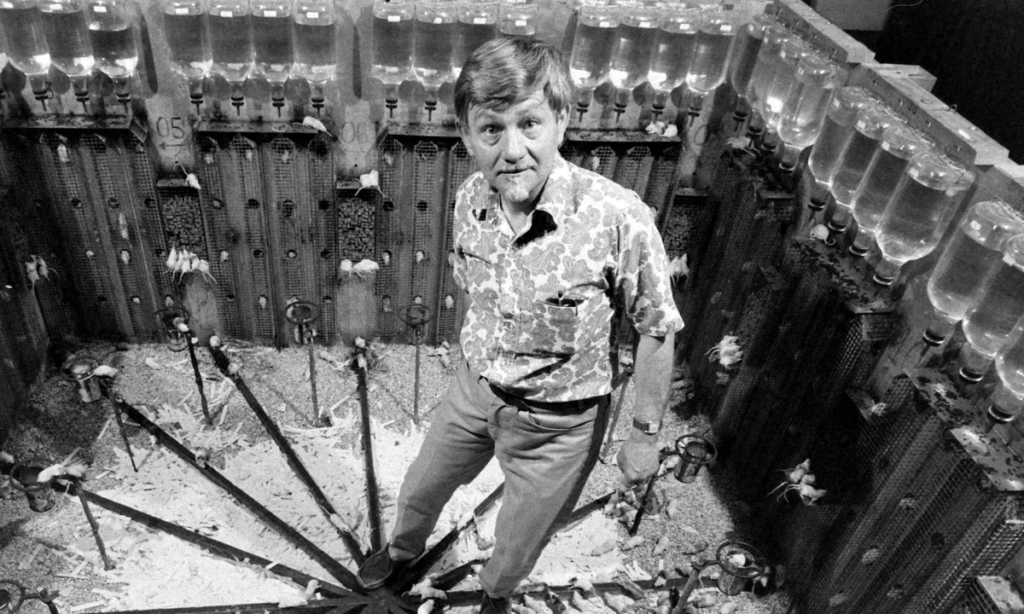
In 1968, an American ethologist named John B. Calhoun built a literal paradise for mice.
He called it Universe 25. It was a carefully designed enclosure at the National Institute of Mental Health where mice had everything. Unlimited food, water, no predators, no disease. Temperature was carefully controlled, nesting material always available, and space big it could comfortably house over 4,000 mice.
It was the most perfect environment a mouse could ever live in.
Until it wasn’t and until every single mouse died!
What!? How? Why?
How It All Started?
Everything started with just four breeding pairs. Eight mice in a world built for thousands.
For the first 100 days, nothing unexpected happened. The mice were just … exploring. Getting used to the space. Calhoun called it the strive phase, mice establishing themselves, learning the territory, finding their place.
Then the population exploded. The whole population double two months. Every 55 days to be exact. Mice formed social groups, established territories, mated, raised pups. A real society took shape — with hierarchies, roles, structure. Normal mouse behavior in abnormal abundance.
It lasted until around day 315. But as the population grew, something changed.
Something happened to the social order.
What Went Wrong in Paradise?
By the time the population hit around 2,200, roughly half of what the space could support, Calhoun started observing behaviors that had no business existing in a world of total abundance.
Male mice that should have been defending territory stopped doing it. They withdrew completely. They didn’t fight, didn’t mate, didn’t engage with the colony at all.
They just sat in open spaces and groomed themselves obsessively. Calhoun called them The beautiful ones. Their fur was perfect, sleek, untouched by conflict. But they were functionally dead. Alive, healthy, well-fed, and completely disengaged from the world around them.
Other males became hyper-aggressive for no reason. The bullies attacked without provocation, sometimes even their own young. Females abandoned pups or stopped reproducing entirely. Infant mortality in the most disrupted groups hit 96%. By day 600, the colony was on an irreversible path to extinction. The last mice alive were physically capable of reproducing but had completely lost the social behaviors required to do so.
And in just less than two years the whole colony died!
It seem that if there’s nothing to fight for, there’s nothing to live for as well.
Calhoun called this the behavioural sink.
The mice had everything. Food, shelter, friends, and maybe even more important, they he no struggle, no stakes, and at the end no reason to engage. Slowly, without any single dramatic moment, the colony just … stopped working.
First came the spiritual death. Mice stopped behaving and being mice. And not long after that, the physical death came as well.
Is modern West a human version of Universe 25?
Let’s look at a modern, specially western civilisation. We have unlimited access to information, entertainment, social connection, education, creative tools, communication — more than any generation in human history. For most people food and clothing are in abundance.
And yet.
Loneliness is at an all-time high. Anxiety and depression rates keep climbing, especially among young people. Birth rates are declining across virtually every developed country. People report having fewer close friends than any previous generation. We’re more connected than ever and somehow more isolated than ever.
The beautiful ones are everywhere. Perfectly curated online personas. Flawless profiles. Zero real engagement. People scroll for hours, consume endlessly, and produce nothing. The sheer volume of stimulation has made meaningful participation feel pointless.
Why post something when a million people already said it better? Why build a relationship when swiping is easier? Why start a project when there are 400 tutorials you haven’t watched yet? Why learn writing and web development when you can type what you want and Claude will spit that out in minutes?
What happens when everything is abundant and nothing requires real effort?
But its not really that simple.
Maybe I’m exaggerating, because it’s worth pointing out that Calhoun’s experiment isn’t a perfect metaphor.
Specially for human development. Mice aren’t people after all, and applying that animal behavior directly to our society oversimplifies things enormously.
Has any of this behavioural sink been tested on people as well?
As a matter of fact it was. Psychologist Jonathan Freedman ran human experiments on crowding in 1975 and found no direct correlation and no significant negative effects on behavior.
And Calhoun himself leaned hard into the dramatic framing as well. He used biblical language, called his paper Death Squared, and pretty much wrote it as a prophecy. The scientific community had valid concerns about how much was being extrapolated from a mouse cage.
But, I think the core observation that social structures can collapse under conditions of abundance and overstimulation, even when physical needs are met, feels harder to dismiss with every passing year.
Especially when you look at the specific behaviours.
The mice in Universe 25 never adapted. They couldn’t build walls. They couldn’t log off. They couldn’t decide to ignore the chaos and focus on what mattered to them. They were mice.
We’re not. The mice couldn’t choose. We can. Whether we actually will is a different question entirely.