In the middle of 2000s, the LEGO Group noticed a significant demographic imbalance.
Boys continued avidly playing with LEGO beyond the age of seven or eight, while most girls lost interest much earlier. Internally, LEGO leaders saw that less than 10 percent of their products were being purchased for girls, meaning half of the youth market was completely ignoring their products.
But it was not like they were not trying.
LEGO had launched at least five girl-oriented product lines in previous decades, from Scala dolls to Belville sets, but these either misinterpreted how girls play or failed to align with LEGO’s core building system.
After almost went bankrupt in 2003 and 2004, the company CEO Jørgen Vig Knudstorp set simple and clear goal. Reach the other half of the world’s children. Girls.
To do so, LEGO opened on a multi-year research to try to understand why girls play differently and what they actually wanted from Lego play.
Five Years of Research
Beginning around 2007, LEGO invested in extensive field research – more cultural anthropology than focus groups – as one report described it. Small teams of LEGO product designers and outside consultants were dispatched to observe and interact with kids (and their parents) in their homes across different cultures, including the U.S., U.K., Germany, and South Korea.
Over four to five years, LEGO’s researchers shadowed about 3,000 kids, studying how they played with construction toys and what kinds of activities and themes excited them. This deep ethnographic approach – literally watching kids play and interviewing families – resulted in rich insights into the play pattern differences between boys and girls.
Notably, it became clear early on that if LEGO was serious about engaging girls, some sacred cows might need to be challenged.
One controversial finding within the company was that the classic boxy LEGO minifigure – the beloved yellow-headed little man – simply didn’t resonate with many girls.
“Let’s be honest: girls hate him,” admitted Mads Nipper, LEGO’s executive VP of products and markets, acknowledging that the standard 4-cm minifig was a turn-off for the girls in their study.
This kind of insight, though unsettling to LEGO traditionalists, set the stage for major design changes ahead.
What did research find?
The research confirmed that girls enjoy building, but in a different style than boys.
While boys tended to build fast and “linear,” racing to finish the kit exactly as shown on the box, girls preferred to take “stops along the way” – pausing during the build to start storytelling, arrange the layout, and engage in role-play with the partially built set.
In short, girls wanted the building process itself to be part of an imaginative narrative, not just a means to an end.
Aesthetics, design and detail were found as high priorities.
As LEGO’s market research manager Hanne Groth summed up, “The greatest concern for girls really was beauty.” Girls wanted their creations to look appealing and “realistic” in a way that spoke to them.
This translated into requests for more interior details (furniture, accessories, decorations) inside builds rather than just shells of buildings.
The research also noted girls’ appreciation for a brighter, more varied color palette – including pastel shades – to make models more visually inviting. At the time, most LEGO sets skewed toward primary colors or “boyish” tones; one parent in the study commented that LEGO suffered from an “aesthetic deficit” for girls.
Girls like relatable characters and friends.
The social aspect of play was a clear pattern. The girls gravitated toward mini-figures they could identify with and imagine themselves as. LEGO observed that boys often play with the standard minifigures in a third-person way – as action heroes or characters – but many girls wanted figures to serve as avatars for themselves.
This finding indicated that the typical blank-faced, gender-neutral minifigure might not cut it; the girls envisioned more detailed characters with names, personalities, and even pets – essentially, friends to join them in their imaginative play.
Along with this came the idea of a narrative setting (like a town or community) that felt familiar and inviting, rather than the battle and adventure themes dominating boys sets.
LEGO learned that girls like construction toys but they just want it to be relevant to them.
The research indicated girls were drawn to scenarios they could find meaningful – whether caring for animals, socializing at a café, or pursuing hobbies – as opposed to the combat, city rescue, or space-fantasy scenarios common in other sets.
Parents and girls in the study explicitly asked for more role-play opportunities and storylines integrated into the building sets.
Designing Lego Friends Based on the Research
Armed with these insights, LEGO’s development team set out to create a new product line that would embody what they had learned.
The result, after much iteration and testing, was LEGO Friends, introduced in late 2011, early 2012.
Nearly every aspect of LEGO Friends was deliberately crafted in response to the research findings: An example of an early LEGO Friends set (Stephanie’s Outdoor Bakery), featuring the new mini-doll figure and pastel-colored, detailed elements.
LEGO designed such sets to incorporate story-driven play, interior details (like kitchen accessories and cupcakes), and a brighter color palette to reflect what girls in their study said they wanted
Perhaps the most significant design change was replacing the classic minifigure with a newly sculpted mini-doll figure.
This new figure is about 5mm taller and more anatomically proportioned (with a distinct feminine shape) compared to the chunky traditional minifigure. LEGO gave the mini-dolls hairpieces, outfits, and facial details that were more lifelike. The idea was to create a figure that girls could more easily identify with – essentially a little friend that looks like them and could serve as their avatar in play.
In total, 29 mini-doll characters were designed for the first year of Friends, including five main characters (Andrea, Olivia, Stephanie, Mia, and Emma) who each came with a name, backstory, and distinct interests. This approach echoed the success of doll lines like American Girl, giving LEGO Friends a built-in cast for storytelling. As one LEGO design director put it, “The girls needed a figure they could identify with… The LEGO team knew they were on to something when girls told them, ‘I want to shrink down and be there.”
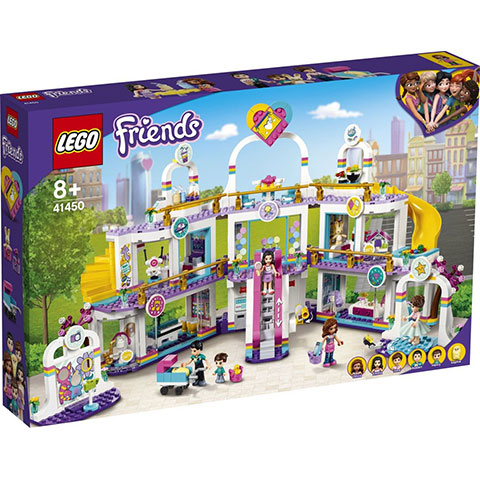
To make the building experience “relevant” and narrative-rich, LEGO Friends introduced the fictional Heartlake City, a colorful suburban town that served as the girls’ shared world. Early sets centered on everyday and aspirational locations a child might find appealing: a café, a veterinary clinic, a treehouse, a beauty salon, a design studio, and so on.
Each of the five main Friends characters had hobbies and settings reflecting different interests – for example, Olivia’s Inventor’s Workshop (to show a science/tech interest) and Mia’s Puppy House (reflecting love of animals) were part of the initial lineup. Variety was meant to break the notion that “boys get adventure, girls get domestic play” – instead, girls could choose from nurturing, creative, sporty, or scientific themes within the Friends universe. The underlying goal was to provide role-play context in every set, so that storytelling could begin even before construction was finished.
Behind the scenes, LEGO treated Friends as one of its biggest product development efforts ever.
Knudstorp had called it “the most significant strategic launch we’ve done in a decade,” and the company pulled talent from across departments to make sure it would succeed. The core design team itself was notably diverse – including designers from nine different nationalities – to ensure the concept would appeal across cultures.
After multiple rounds of concept testing with kids and parents, and after refining everything from the mini-doll’s look to the snap-on accessories, LEGO Friends was ready to make its debut.
Lego Friends: The Launch
LEGO Friends was officially introduced in January 2012 (with some early releases in late December 2011). The launch was backed by a $40 million global marketing campaign! – a level of marketing spend usually reserved for LEGO’s blockbuster themes like Star Wars. LEGO made sure that toy stores and media outlets knew this wasn’t a niche side project but a major new line.
The sets hit shelves positioned to attract girls who might not venture into the LEGO aisle. In many stores, Friends products were placed in or near the traditional girls’ toys section, alongside dolls and playsets, rather than strictly with other LEGO – a deliberate effort to reach girls directly.
TV commercials and LEGO Club magazine features for Friends depicted girls building and role-playing together in Heartlake City, emphasizing friendship and fun over competition. The branding was bright, rounded, and heavy on purples and pinks to immediately signal a break from the usual primary-colored LEGO look.
From day one, sales of LEGO Friends exceeded expectations!
In the first months of 2012, retailers reported Friends sets flying off the shelves – confirming that there was indeed pent-up demand among girls for this kind of building toy. By mid-2012, LEGO announced the new line was a runaway hit, selling twice as many sets as forecast.
Friends became one of the year’s top-selling toy lines, contributing to a 24% surge in LEGO’s overall sales and a 35% jump in profits for the first half of 2012.
Jørgen Vig Knudstorp, the CEO, noted “an enthusiastic welcome” for the Friends range and called the results “astonishing.” Internally, this validation was huge: years of research and a risky investment in new designs had paid off in both financial and mission terms – LEGO was finally engaging many girls who previously felt LEGO wasn’t for them.
However, the launch also sparked immediate controversy and debate in the public sphere.
Virtually as soon as Friends was unveiled, blogs, petitions, and op-eds lit up with strong opinions – both positive and negative – about LEGO’s new direction.
Gender Stereotypes or Just Good Marketing?
LEGO Friends triggered an international debate about gender and toys. On one side, many parents, educators, and activists accused LEGO of reinforcing traditional gender stereotypes under the guise of listening to girls.
Critics pointed out that the Friends world revolved around cafés, beauty shops, bakeries, and domestic or leisure scenes, packaged in a sea of pink and purple – essentially, “a little pink ghetto” in the words of one observer. An opinion piece in Time summarized protesters’ view that Friends “promotes damaging gender stereotypes and limits creativity and healthy role development.”
Advocacy groups like Pink Stinks in the UK argued that LEGO was needlessly gendering a toy that should be for all children, saying the company had “perpetuated a narrow and limited set of ideas” for girls – focused on “cupcakes, parties and leisure”, which they found “tiresome and heavily stereotyped.” In the U.S., a petition spearheaded by the girls’ empowerment organization SPARK Movement amassed over 50,000 signatures in 2012, calling on LEGO to stop “selling out girls” with such gender-specified marketing.
The petition and its supporters urged LEGO to include more female characters in non-Friends sets and to market all LEGO themes in a gender-neutral way, rather than creating a separate pink world for girls.
Another flashpoint of criticism was the new mini-doll figure. Some commentators (and even health professionals) blasted the mini-dolls as overly sexualized or body-conscious for a children’s toy – noting that the figures are slim, with defined breasts and dressed in fashionable outfits.
An eating disorder specialist wrote that the Friends line was “catering to girls’ appearance-focused culture” and could fuel body image issues. Side-by-side comparisons of a standard chunky minifigure and the taller mini-doll circulated online with derisive commentary that LEGO had put its figures on a diet to appease girls.
LEGO did have its defenders as well!
Many parents welcomed LEGO Friends, noting that it finally drew their daughters into building. These fans argued that listening to girls’ preferences isn’t sexism – it’s smart design. One science writer pointed out that building and spatial skills are crucial for girls, and if pastel bricks and cute characters are what get them building, that’s ultimately a win for STEM education.
Others noted that the Friends theme, despite its feminine veneer, still fundamentally involves constructing models, following instructions, and imaginative play – the same skills LEGO has always promoted. Even within feminist circles, there was nuance: some lamented the stereotypes but acknowledged LEGO’s dilemma.
Aftermath
In purely commercial terms, LEGO Friends was a triumph.
The product line sustained strong sales in the years following 2012, eventually growing to include hundreds of sets, spin-off products like books and an animated series, and helping LEGO claim a bigger share of the girls’ toy market.
By engaging girls, LEGO Friends contributed to the company’s climb to become (briefly) the largest toy company in the world around 2014–2015. Perhaps more importantly, it brought countless girls into the LEGO hobby. Many parents reported that their daughters who previously ignored LEGO bricks were now enthusiastically building elaborate houses, stables, and even repurposing parts from Brothers’ or parents’ sets into their Heartlake stories.
Over time, the theme itself also broadened: new waves of Friends sets introduced more diverse activities – from soccer practice and science labs to camping trips and rescue missions – partly in response to feedback to move beyond cafes and salons.
The five main characters gained depth and new interests (for example, Andrea became a pop star in one sub-theme, Olivia pursued science and even astronomy in later sets, etc.), showing LEGO’s effort to balance girly themes with empowering ones.
Crucially, LEGO did not look away and dismiss the criticism but actively engaged with it.
In early 2012, after the outcry, LEGO representatives met with members of SPARK and other critics to discuss concerns. The company subsequently partnered with SPARK activists in an initiative to eliminate gender stereotypes in its products and marketing. One concrete result was that LEGO promised and began to include more female characters across all its product lines – not just in Friends. In the years following, fans noticed an uptick in female minifigures in traditionally male-oriented themes (e.g., female firefighters and police in City sets, a female scientist in collectible minifigs, and prominent heroines in action themes).
LEGO also revisited its advertising and packaging: the company started showing boys and girls together in marketing images for sets, and removed explicit “for girls” or “for boys” labels. In fact, the internal fallout from the Friends debate led LEGO to create new internal gender marketing guidelines pushing for more inclusive marketing of all LEGO set.
This represented a shift in philosophy: LEGO would continue to make themes like Friends, but also strive to make its overall portfolio more balanced and accessible to any child.
In the long run, LEGO’s stance evolved toward greater gender neutrality.
By 2021, responding to new research on children and stereotypes, LEGO officially announced it would no longer market toys by gender and would remove gender biases from its product line. For example, on LEGO’s website, users can no longer filter products by boys or girls, and marketing imagery portrays children of all genders playing with all types of sets. This policy shift can be seen as a direct continuation of the lessons learned from the LEGO Friends journey and the feedback it provoked.
The development of LEGO Friends stands as a fascinating case of a company combining deep research with bold innovation.
Sources
- Bloomberg Businessweek
- The Guardian (2012)
- Time Magazine (2012)
- Wired (2012)
- Lego