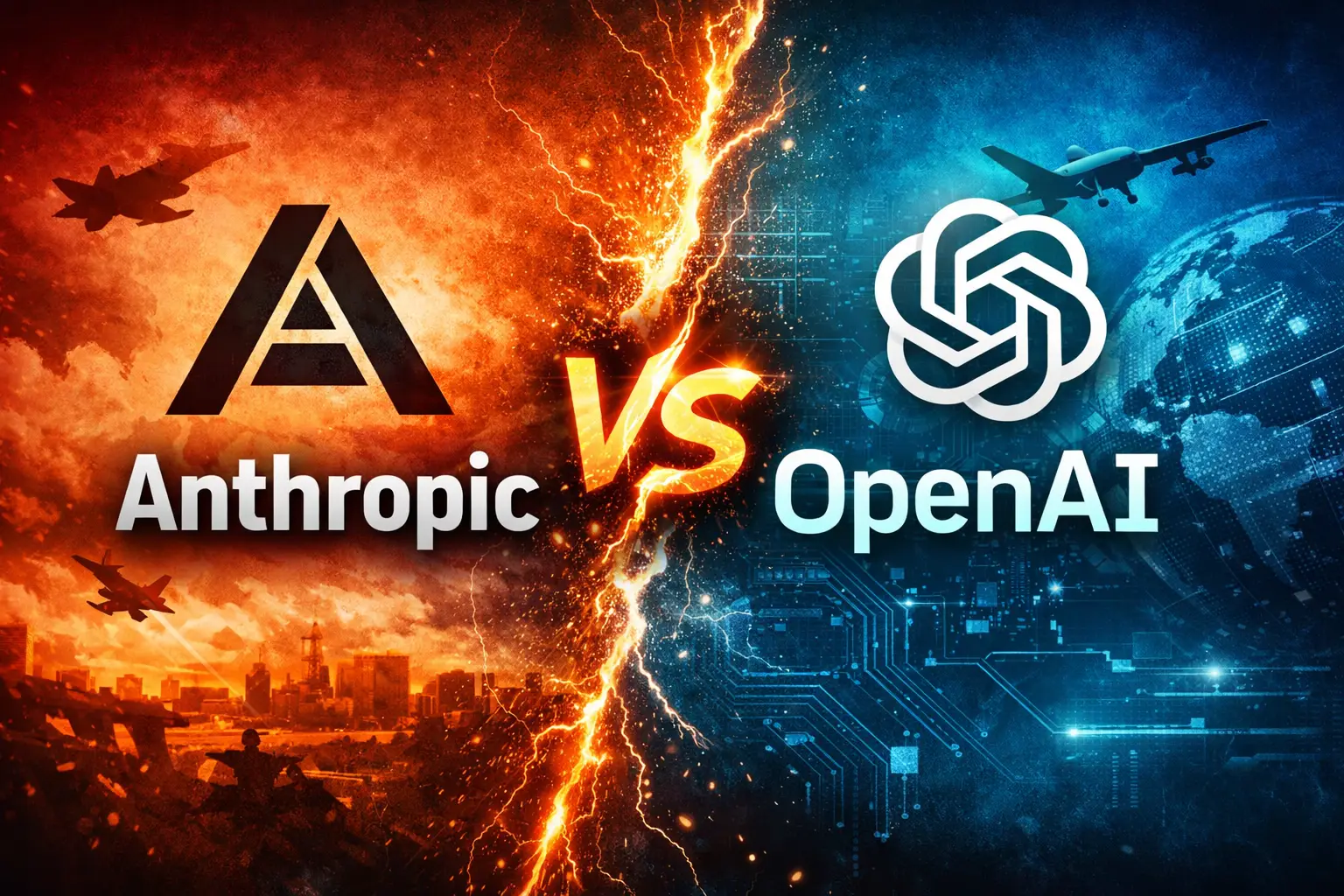

The “SaaS is dying” narrative gained serious momentum after Anthropic’s Claude Cowork demo wiped $285 billion off tech stocks in 24 hours in February 2026.
But more detailed look tells a more interesting story for business owners. The global SaaS market actually grew from $266 billion in 2024 to ~$315 billion in Q1 2026.
Why is everyone saying that SaaS is dying?
Because some really is, and even more because it looks like it is if you spend too much time on Linkedin or X.
What’s actually happening is a very strong and obvious split!
Mission-critical, workflow-embedded, data-rich software – aka AI powered solutions that bring visible results (and have usage or result based pricing) thrive more then ever. But simple point solutions like form builders, basic CRMs, landing page generators, lightweight project management … face existential pressure from vibe coding tools – aka slowly dying.
And if you’re building or thinking about building something, this is the most important thing to understand right now.
Gartner estimates 35% of SaaS tools designed to solve one particular business problem, function, or niche requirement, will be replaced by AI agents or absorbed into larger ecosystems.
So when someone tells you SaaS is dead, ask them which SaaS they mean.
The simplicity layer that anyone can vibe-code in a weekend? Sure, that can be debated.
But software that sits deep inside workflows, holds proprietary data, and solves domain-specific problems?
That’s more valuable than ever.
The new moats are not features. They’re data, vertical expertise, regulatory compliance, and context.
Vertical beats horizontal — every time!
Here’s a pattern worth paying attention to: vertical AI companies reach $5 million ARR in 24 months.
Traditional SaaS takes 37 months.
Harvey, the legal AI platform, hit $100 million ARR. At least six customer service AI companies crossed the same mark.
And yet, most builders still default to horizontal.
They build the “AI assistant for everyone” or the “all-in-one platform for businesses.” There are 70+ companies building horizontal AI SDRs as I write this blog.
How many of them will survive you think?
I wouldn’t bet on most of them.
The ones winning are the ones going narrow. One industry. One workflow. One painful problem that generic tools can’t solve because they don’t understand the context.
A dentist in Munich and a sales rep for construction company in Ljubljana have a pretty, pretty, pretty different workflows, compliance requirements, terminology, and customer expectations.
An AI agent that works for both of them works great for neither.
Vertical depth is the new competitive advantage. And it’s especially powerful when you combine it with something that most US-focused builders overlook entirely.
25 million European SMEs are waiting
This is the number that stopped me cold when I was going through the research: only 13.5% of EU enterprises have adopted AI.
European organizations lag behind the US by 50-70% in AI adoption.
In SME less than 12% use AI tools in a structured way that is not a random ChatGPT conversation. 46% of European SMEs state they are using basic tools like ChatGPT.
They’ve started, but they just have no system, no structure, no strategy. Only 29% provide any AI training to staff. Half of SME leaders don’t even understand how AI fits their business.
So you’ve got 25 million businesses that know they need AI, are already experimenting with it, but have zero tools built for their reality.
And almost nobody is building for them. Yet.
Is the EU regulation really the problem?
I’d say the regulatory angle makes this even more interesting.
The EU AI Act, GDPR, DORA, NIS2 … the list is long … but a lot of founders and business owners I talk to see it as a problem, while I think it could be perceived as a moat.
If you’re already EU-based, you understand (to some extent) the compliance landscape from the inside. US competitors need to build separate infrastructure, hire European legal teams, and navigate a regulatory environment they barely follow. That takes time and money they’d rather spend on their home market.
For builders in Europe, this can be used as an advantage.
Specially now, with that red haired douchebag in the office, EU should (and will) look inward. And start building for itself. By itself.
But no matter the global appetites, local reach or tech stack, one thing is very very sure and obvious.
It’s not the SaaS model that is dying, but it’s pricing is
Classic per-seat pricing is dying. But that’s not a completely new news. Gartner states that last year 85% of SaaS companies already use some form of usage-based pricing. Which is a major jump from just 30% in 2019.
The most cited example is Intercom’s pricing model — $0.99 per resolved customer ticket — which generated tens of millions in revenue within its first year.
This matters because it changes what you build and how you think about value.
If you’re charging per outcome — per resolved ticket, per qualified lead, per completed onboarding — then your product needs to actually deliver measurable results. No more selling access, vanity metrics and nice UI.
You’re selling performance.
For small teams, this is great news. You don’t need massive sales organizations or enterprise contracts. You need a product that demonstrably works, priced in a way that makes the ROI obvious to a business owner who checks their bank account every morning.
So … what does that mean?
Although the times are tough, the opportunities are vast.
I believe the biggest one right now is vertical AI tools built specifically for European SMEs.
No, I dont mean another AI chat for everything, but specific tools for specific industries, with native language support and EU compliance built in from day one.
The data backs this up. But more than data, I see it in conversations with business owners around me — people who are eager, curious, already paying for ChatGPT, and completely lost when it comes to integrating AI into how they actually work.
That gap between curiosity and adoption? That’s the business.
The window won’t stay open forever. Large players will notice the European SME market and their needs. Regulation will get easier to navigate as tooling matures. And the AI adoption curve will flatten as the early wave passes.
But right now, there’s a massive mismatch between demand and supply. And if you’re a small team in Europe that can ship fast and go deep into one vertical, I think you’re sitting on an opportunity that most people writing SaaS is dead are missing.